

The challenges that define the success of regeneration
Many initiatives remain at the pilot stage, with reports or metrics disconnected from day-to-day operations. Scaling up requires effective operation, governance, and meaningful measurement for decision-making. These are the key challenges to address from the program design stage.

From the strategy
to adoption
in the field
Regeneration fails when it remains stuck in strategy or data. Many initiatives get stuck in pilot programs without scalability, measurements disconnected from management, or generic recommendations that are difficult to implement. The challenge is to translate ambition into operational decisions and field routines.

Scalability and adoption in the producer network
What works in a pilot program doesn't always work across hundreds or thousands of hectares. Without clear incentives, support, and practical training, adoption slows, and variability between farms dilutes results. The challenge is to standardize without losing local adaptation.

Useful, comparable, and business-oriented measurement
Measuring for the sake of measuring changes nothing. When indicators are not comparable, are not linked to concrete practices, or are not connected to productivity, risk, and cost, regeneration loses internal momentum. The challenge is to build actionable, auditable metrics linked to ROI and risk.

Internal alignment and program governance
Without clear governance, regeneration becomes a piecemeal effort, involving departments like sustainability, procurement, agronomy, sales, and data. Roles, processes, prioritization criteria, and a shared roadmap are lacking. The challenge is to align these areas and transform the program into consistent implementation, not isolated initiatives.
Solutions to convert regeneration
in execution and impact
A practical approach, supported by sound diagnosis, technical assistance, and applied training, helps to make more accurate decisions in the field, optimize management, make better use of resources, and strengthen the resilience of the production system, with measurable improvements season after season.
Program design and scaling roadmap
Translate the strategy into an operational plan: objectives, scope, segmentation (crop/zone/type of producer), priorities and a scaling roadmap with clear milestones and decision criteria.

Scalable practice packages
Turn ambition into practical elements by crop and region: what to do, when to do it and with what minimum requirements that have specific, realistic and easy to apply in the field.
Adoption and applied training
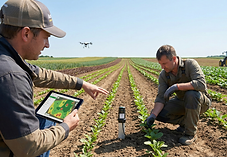
Promote adoption with practical training for internal teams and producers, use clear materials and provide support at critical moments; that is, less theory and more implementation and consistency.

Governance and continuous improvement of the program
Establish roles, processes, and monitoring cadences to align areas and sustain execution. Turn learnings into adjustments and standards, campaign after campaign.

Comparable, useful measurement connected to management
Define real, actionable and comparable KPIs, data capture and quality protocols, and a tracking system that connects practices with results, facilitating decisions and traceability.

Services designed to facilitate scalability
We accelerate the scalability of your regenerative strategy with services that transform vision into consistent execution. We integrate program design, implementable practices, training, and governance, with comparable measurement to guide decisions and demonstrate impact.


